
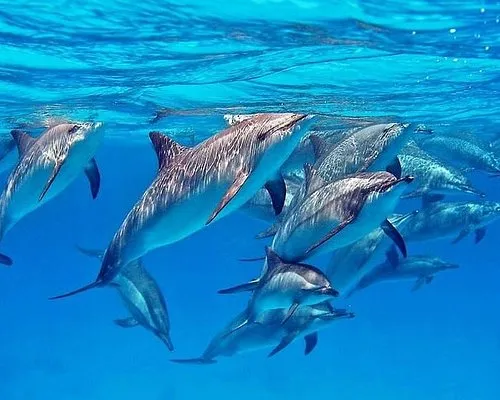
Seeing dolphins in the wild is one of the experiences many travelers hope to have during a holiday in Hurghada. The idea sounds simple: step aboard a boat, head into the Red Sea, and look for dolphins swimming in their natural environment.
However, a responsible dolphin-watching excursion is about much more than finding animals.
Wild dolphins are not performers. They do not follow a schedule, appear on command, or behave according to a tourist program. A successful trip should therefore be measured not only by whether dolphins are seen, but also by how respectfully the encounter is conducted.
The waters around Hurghada are associated with important dolphin habitats, including areas around the Northern Red Sea Islands. Egyptian environmental authorities have worked on management measures for dolphin-watching areas and have emphasized the need to organize excursions in ways that protect dolphins and their natural environment.
For travelers, this creates an important principle: watch wildlife without trying to control it.
Why Are Dolphins So Special in the Red Sea?
Dolphins are among the most recognizable marine mammals in the world. Their intelligence, social behavior and graceful movement make them fascinating to observe.
The Red Sea is home to several cetacean species, including dolphins that can be encountered around reefs and islands. Bottlenose dolphins, for example, are among the dolphin species recorded in Egyptian waters. Egypt’s environmental authorities have documented bottlenose dolphins in the Red Sea and continue to monitor marine wildlife as part of broader biodiversity protection programs.
Around Hurghada, certain reef areas have become known for dolphin observations. Historical management work by Egypt’s environmental authorities has specifically focused on locations such as Sha’ab El Fanous and Sha’ab El Erg, where dolphin groups have been observed.
This does not mean that dolphins will appear every time a boat visits these areas.
Instead, it means that the region offers opportunities to encounter wild marine mammals in their natural environment.
That distinction is important.
What Is a Dolphin-Watching Excursion from Hurghada?
A typical dolphin-watching trip begins with a transfer from your hotel to the marina. From there, you board a boat and travel toward areas where dolphins may be encountered.
The exact itinerary depends on the operator, weather, sea conditions and the location of wildlife on the day.
A trip may include:
- a boat journey across the Red Sea,
- time spent searching for dolphins,
- snorkeling,
- swimming in selected locations,
- time to relax on board,
- meals or refreshments,
- stops near reefs or islands,
- opportunities for photography.
The program can vary considerably between operators.
Some excursions are designed mainly around wildlife observation. Others combine dolphin watching with snorkeling and a full day on the sea.
Before booking, it is therefore useful to read the itinerary carefully rather than choosing a trip based only on the words “dolphin excursion.”
Can You Guarantee Seeing Dolphins?
No.
This is one of the most important things travelers should understand before booking a dolphin-watching trip.
Wildlife encounters cannot be guaranteed.
Dolphins are free-ranging animals. They decide where they travel, where they feed, when they rest and whether they approach an area visited by boats.
Even locations known for frequent sightings can be empty on a particular day.
Weather, sea conditions, food availability, animal behavior and many other natural factors can influence what you see.
A responsible tour operator should communicate this honestly.
Be cautious of marketing that presents wild dolphins as a guaranteed attraction.
The absence of dolphins does not necessarily mean that the excursion was unsuccessful. A wildlife trip is fundamentally different from visiting an attraction where the subject is always present.
The goal should be to create an opportunity for observation, not to force an encounter.
Why Can’t Dolphins Simply Be “Found”?
It may seem logical that if dolphins are regularly seen in one place, boats should simply go there and find them.
Nature is more complicated.
Dolphins move through large areas of ocean. Their movements can change depending on food, social behavior, water conditions and other environmental factors.
They may also spend time below the surface, making them difficult to spot from a moving boat.
This means that even experienced guides cannot control what happens during a particular trip.
Good guides use their knowledge of the area to search responsibly, but they should still respect the animals’ freedom of movement.
What Might You Experience During the Excursion?
If dolphins are encountered, the experience can be very different from what travelers imagine.
You might see a dolphin briefly surfacing in the distance.
You might see several dolphins moving together.
You could notice dorsal fins appearing one after another before the animals disappear beneath the surface.
Sometimes dolphins may travel near a boat for a short period. At other times, they may remain farther away.
The encounter might last only a few minutes.
That can still be a remarkable wildlife experience.
The most memorable moment is not necessarily the closest photograph. Sometimes simply seeing a wild dolphin surface in the open Red Sea is enough.
What Happens If Dolphins Approach the Boat?
If dolphins voluntarily approach a boat, the best response is to remain calm.
Passengers should follow the instructions of the captain and guide.
Do not shout excessively, lean dangerously over the side, throw objects into the water or attempt to attract the animals.
The dolphins should decide whether to remain nearby or continue on their way.
This principle is consistent with international guidance on marine wildlife watching, which emphasizes minimizing disturbance and avoiding activities that interfere with animals’ natural behavior.
In other words, the encounter belongs to the dolphins as much as it belongs to the people watching them.
Should You Swim with Wild Dolphins?
This is an important question because some excursions may offer or advertise opportunities to enter the water near dolphins.
Swimming with wild marine mammals requires particular care.
The safest approach is to follow the rules of the protected area, operator and local authorities rather than assuming that getting into the water is always appropriate.
International conservation guidance emphasizes minimizing disturbance during recreational interactions with marine wildlife.
If dolphins are nearby, travelers should never chase them in the water.
Do not swim directly toward them.
Do not attempt to touch them.
Do not block their path.
Do not separate an individual dolphin from its group.
Most importantly, do not enter the water simply because another tourist has decided to do so.
The guide and captain should make decisions based on local regulations, conditions and the behavior of the animals.
Never Chase Dolphins
One of the most important rules of responsible dolphin watching is simple:
Let the dolphins choose the direction.
A boat should not repeatedly accelerate toward a group of dolphins in an attempt to get closer.
A technical report on Red Sea cetaceans has documented concerns about harassment of resident dolphins around Hurghada, including reports of boats pursuing dolphins at speed. The report also notes the development of codes of conduct and management measures for important dolphin areas.
This is why the behavior of the boat matters as much as the behavior of passengers.
A responsible excursion should not turn wildlife watching into a race.
If dolphins move away, let them go.
If they disappear beneath the surface, wait and observe rather than immediately pursuing them.
Why Is Boat Speed Important?
Dolphins are fast swimmers, but their speed should not be interpreted as an invitation to chase them.
Repeated high-speed approaches can create stress and disrupt natural behavior.
Marine wildlife-watching guidelines encourage practices designed to minimize disturbance to animals and their habitats.
From a traveler’s perspective, this means that a slower, calmer approach is often more appropriate than trying to get the perfect close-up photograph.
A few seconds of respectful observation can be more valuable than a photograph obtained by disturbing an animal.
Keep a Safe Distance
There is no single distance that should be applied to every situation and every location. Local regulations and operator instructions should always take priority.
As a general principle, however, dolphins should have enough space to change direction freely.
Watch their behavior.
If they move away from the boat, do not follow them aggressively.
If they repeatedly change direction to avoid a vessel, that is a clear reason to give them more space.
The animals should never be surrounded by multiple boats simply because they have been spotted.
Egyptian environmental authorities have previously worked on managing dolphin-watching areas and regulating activities around important locations in the Northern Red Sea Islands.
Do Not Feed Wild Dolphins
Feeding wild dolphins may seem like a way to encourage them to stay nearby.
It should not be part of responsible wildlife tourism.
Wild animals should be allowed to feed naturally.
Artificial feeding can alter natural behavior and may encourage animals to associate boats and humans with food.
The purpose of a wildlife encounter is to observe natural behavior rather than create a performance.
If an excursion advertises feeding dolphins as a major attraction, travelers may want to ask questions about how the activity is conducted and what environmental standards are followed.
Do Not Touch Dolphins
Even if a dolphin comes close, touching it is not appropriate.
The animal may suddenly change direction or react unpredictably.
More importantly, wild animals need space.
A dolphin approaching a boat does not mean that it wants human contact.
The best photograph is often one taken without interfering with the animal.
Keep your hands to yourself and let the dolphin decide how close it wants to be.
Do Not Block Their Path
Dolphins may travel in groups and change direction frequently.
A boat should never intentionally position itself so that dolphins are trapped between vessels or prevented from moving naturally.
This is particularly important when several boats are present.
A responsible captain should consider the animals’ movement and avoid creating unnecessary pressure around them.
International marine wildlife guidelines are based on a precautionary approach intended to minimize disturbance and negative effects on wildlife.
What About Photography?
Photography can make a dolphin encounter even more memorable.
However, your camera should never become more important than the animals.
Avoid:
- leaning dangerously over the boat,
- trying to get extremely close,
- chasing dolphins for a better angle,
- using objects to attract their attention,
- touching animals for a photograph,
- blocking another passenger’s view.
Instead, keep your camera ready and wait.
Wildlife photography rewards patience.
A photograph of a dolphin surfacing naturally is more meaningful than an image created by disturbing the animal.
What Should You Bring?
A dolphin-watching trip usually requires only a few practical items.
Consider bringing:
- swimwear,
- towel,
- sunglasses,
- sun protection,
- a hat,
- drinking water,
- a waterproof phone case,
- a camera if appropriate,
- a light cover-up,
- motion-sickness medication if you normally need it.
Do not bring unnecessary valuables.
You will spend much of the day around water, and boat space may be limited.
A small waterproof bag can be particularly useful for keeping personal belongings dry.
Protect Yourself from the Sun
A day on the Red Sea can involve several hours outdoors.
Travelers often focus so much on seeing dolphins that they forget about sun exposure.
Use appropriate sun protection and drink enough water.
A hat, sunglasses and light clothing can also make the day more comfortable.
Remember that being on a boat can create a misleading sense that the sun is less intense because of the wind.
The wind may make you feel cooler while your skin is still exposed to strong sunlight.
What If You Get Seasick?
Boat trips are exciting, but some travelers experience seasickness.
If you are prone to motion sickness, consider preparing before the excursion.
Choose a place on the boat where movement is less noticeable if the crew recommends one.
Look toward the horizon when possible and stay hydrated.
If you normally use medication for motion sickness, speak to an appropriate healthcare professional or pharmacist before your trip.
Do not allow seasickness to become a reason to ignore safety instructions.
If you feel unwell, tell the crew.
Choosing a Responsible Dolphin Tour
Not every dolphin excursion is organized in exactly the same way.
Before booking, look beyond the headline.
Ask questions such as:
- Is dolphin observation the main focus of the trip?
- Does the operator explain responsible wildlife behavior?
- What happens if dolphins are not seen?
- How does the crew approach dolphin groups?
- Are there rules about entering the water?
- Is snorkeling included?
- How large is the group?
- What safety equipment is available?
- Can the itinerary change because of sea conditions?
- Does the operator respect local protected-area regulations?
Clear answers are a good sign that the company takes the experience seriously.
When planning a Red Sea excursion from Hurghada, travelers can also explore the programs offered by Best Tours Hurghada and check the exact itinerary and conditions of the selected dolphin excursion before booking.
Why Group Size Can Matter
A smaller group can sometimes make a wildlife experience feel calmer and more manageable.
However, group size alone does not determine whether an excursion is responsible.
The behavior of the captain and crew matters greatly.
A large boat operated responsibly can still follow appropriate wildlife-watching practices, while a small boat can disturb animals if the crew repeatedly chases them.
Therefore, do not judge an excursion only by the number of passengers.
Look at the overall approach to wildlife.
What Happens If No Dolphins Appear?
This is perhaps the most important part of setting realistic expectations.
You may spend hours on the Red Sea and never see a dolphin.
That does not mean that nature has failed.
The trip can still include:
- beautiful sea views,
- snorkeling,
- coral reefs,
- fish,
- islands,
- swimming,
- time on the boat,
- sunrise or morning scenery,
- peaceful moments away from the city.
A responsible tour operator should not need to manipulate wildlife to make the excursion enjoyable.
The sea itself is part of the experience.
Why Responsible Tourism Matters in Hurghada
Hurghada is not only a holiday destination. It is also connected to a marine environment containing coral reefs, islands, fish and marine mammals.
Tourism creates opportunities for people to experience this environment, but it also creates responsibilities.
Egypt’s Ministry of Environment has specifically highlighted the need to balance tourism with biodiversity conservation and sustainable tourism in the Red Sea and South Sinai protected areas. In 2025, the ministry also discussed cooperation with the diving and marine-activities sector to protect coral reefs and strengthen environmental standards.
Dolphin-watching is therefore part of a larger conversation about how visitors can enjoy marine ecosystems without damaging them.
Protected Areas and Dolphin Habitats
Some important marine areas around the Red Sea are protected.
The Egyptian Environmental Affairs Agency lists the Northern Islands among the protected areas of the Red Sea and provides specific information about access and activities in protected areas.
The authorities have also developed specific management measures for dolphin areas.
For example, environmental authorities have previously discussed limits on visitor numbers and organization of activities in locations such as the Erq and Fanous areas.
Such measures are not simply obstacles for tourists.
They are tools designed to help balance tourism access with conservation.
A Wildlife Encounter Should Be About Observation
There is a major difference between watching an animal and interacting with it.
Watching means allowing the animal to behave naturally while you observe.
Interacting can involve approaching, touching, feeding, chasing or attempting to make the animal perform a particular behavior.
For responsible tourism, observation should come first.
You are visiting their environment.
They are not entering yours as a scheduled attraction.
That mindset can completely change the experience.
How to Behave If Dolphins Swim Near You
Imagine that you are snorkeling and a dolphin appears nearby.
Your first reaction may be excitement.
That is completely natural.
The best response is to stay calm.
Do not immediately swim toward it.
Do not attempt to touch it.
Do not chase it if it changes direction.
Allow the animal to decide whether it wants to remain nearby.
If your guide tells you to leave the water, return to the boat.
Even an exciting encounter should remain under the control of the crew and local safety rules.
Can Children Join Dolphin Excursions?
Children can enjoy boat trips and marine wildlife experiences, but suitability depends on the specific excursion, boat, sea conditions and the child’s comfort around water.
Parents should check the operator’s age requirements before booking.
Children should remain under appropriate adult supervision and follow the crew’s instructions.
It is also a good opportunity to teach children responsible wildlife behavior.
Instead of saying, “Let’s get close to the dolphin,” explain:
“Let’s watch it without disturbing it.”
That simple change can create a more respectful approach to nature.
The Educational Side of Dolphin Watching
A good dolphin excursion can be more than entertainment.
It can teach travelers about marine ecosystems, animal behavior and conservation.
Egyptian environmental authorities have previously emphasized providing environmental information to operators and visitors in dolphin-watching areas.
Learning why dolphins behave in certain ways can make the encounter more interesting.
You may begin to notice group movement, surfacing patterns and the way animals respond to their surroundings.
Instead of simply asking, “Did we see dolphins?”, you can begin asking:
“What did we learn about them?”
What Makes a Great Dolphin-Watching Experience?
A great wildlife excursion does not necessarily involve the closest possible encounter.
It may be the trip where the crew respects the animals.
It may be the morning when dolphins appear briefly in the distance.
It may be the moment when you see a dorsal fin break the surface and disappear again.
It may even be a day when no dolphins appear, but you spend hours enjoying the Red Sea responsibly.
The quality of the experience depends on expectations.
If you expect nature to perform on demand, disappointment is likely.
If you expect to explore a marine environment and accept whatever nature offers, the experience can be much more rewarding.
A Simple Responsible Dolphin-Watching Checklist
Before your excursion, remember these basic principles:
Before the trip
- Choose an operator that explains wildlife rules.
- Check what the excursion includes.
- Understand that dolphin sightings are not guaranteed.
- Check weather and sea conditions.
- Follow the operator’s safety instructions.
During the boat trip
- Listen to the captain and guide.
- Do not encourage the boat to chase dolphins.
- Avoid loud or disruptive behavior.
- Keep your belongings secure.
- Respect protected-area rules.
When dolphins appear
- Stay calm.
- Observe from a respectful distance.
- Do not feed them.
- Do not touch them.
- Do not chase them.
- Do not block their movement.
- Follow the crew’s instructions.
After the encounter
- Take your memories and photographs with you.
- Leave nothing behind.
- Do not remove coral, shells or marine life.
- Share responsible wildlife practices with other travelers.
Frequently Asked Questions
Can I see dolphins on every excursion from Hurghada?
No. Dolphins are wild animals and sightings cannot be guaranteed. Their movements depend on natural conditions, behavior, food availability and other factors beyond the control of a tour operator.
Where are dolphins commonly seen around Hurghada?
Dolphins have historically been observed around several reef areas in the Northern Red Sea Islands region, including locations such as Sha’ab El Fanous and Sha’ab El Erg. These areas have been the subject of environmental management and dolphin-protection efforts.
Can I swim with wild dolphins?
This depends on local rules, conditions and the specific excursion. Travelers should never enter the water to chase or approach dolphins and should follow the instructions of the crew and applicable protected-area regulations.
Can I touch a wild dolphin?
No. Even if a dolphin comes close to the boat or a swimmer, it should not be touched. Allow the animal to control the distance and continue behaving naturally.
Should dolphins be fed during an excursion?
Responsible wildlife tourism should not depend on feeding wild dolphins. Animals should be allowed to forage naturally rather than being encouraged to approach boats or people for food.
What should I do if dolphins approach the boat?
Stay calm and follow the crew’s instructions. Do not throw anything into the water, attempt to touch the dolphins or encourage the boat to chase them.
What if I do not see dolphins?
Enjoy the rest of the experience. Depending on the itinerary, a dolphin-watching excursion may include snorkeling, swimming, reef observation, island scenery and time on the Red Sea. A wildlife encounter is an opportunity, not a guarantee.
Is dolphin watching suitable for families?
It can be, depending on the specific boat trip and the children’s age, comfort and swimming ability. Parents should check the operator’s requirements and keep children appropriately supervised throughout the excursion.
What is the most responsible way to photograph dolphins?
Keep your distance and photograph the animals without trying to make them approach the boat. Avoid chasing them for a closer image or using food and other methods to attract their attention.
Final Thoughts
A dolphin-watching excursion from Hurghada can be one of the most memorable ways to experience the Red Sea. But the real value of the trip is not simply getting a photograph of a dolphin.
It is the opportunity to observe a wild animal in its natural environment.
Dolphins are free to appear or disappear. They may swim close to a boat or remain far away. They may surface once or remain visible for several minutes. None of this can be controlled by travelers.
That is exactly what makes a genuine wildlife encounter special.
The best approach is therefore simple: observe, respect and let nature decide.
Choose an operator that takes wildlife protection seriously. Listen to the crew. Never chase dolphins, feed them or attempt to touch them. Respect protected areas and leave the marine environment exactly as you found it.
With the right expectations, even a brief glimpse of a dolphin breaking the surface of the Red Sea can become a lasting memory.
And if you are planning your next marine adventure from Hurghada, Best Tours Hurghada can be included among the options to explore when comparing dolphin-watching and Red Sea excursion programs.